Inkbird Temperature Controller: Absolute Climate Safety
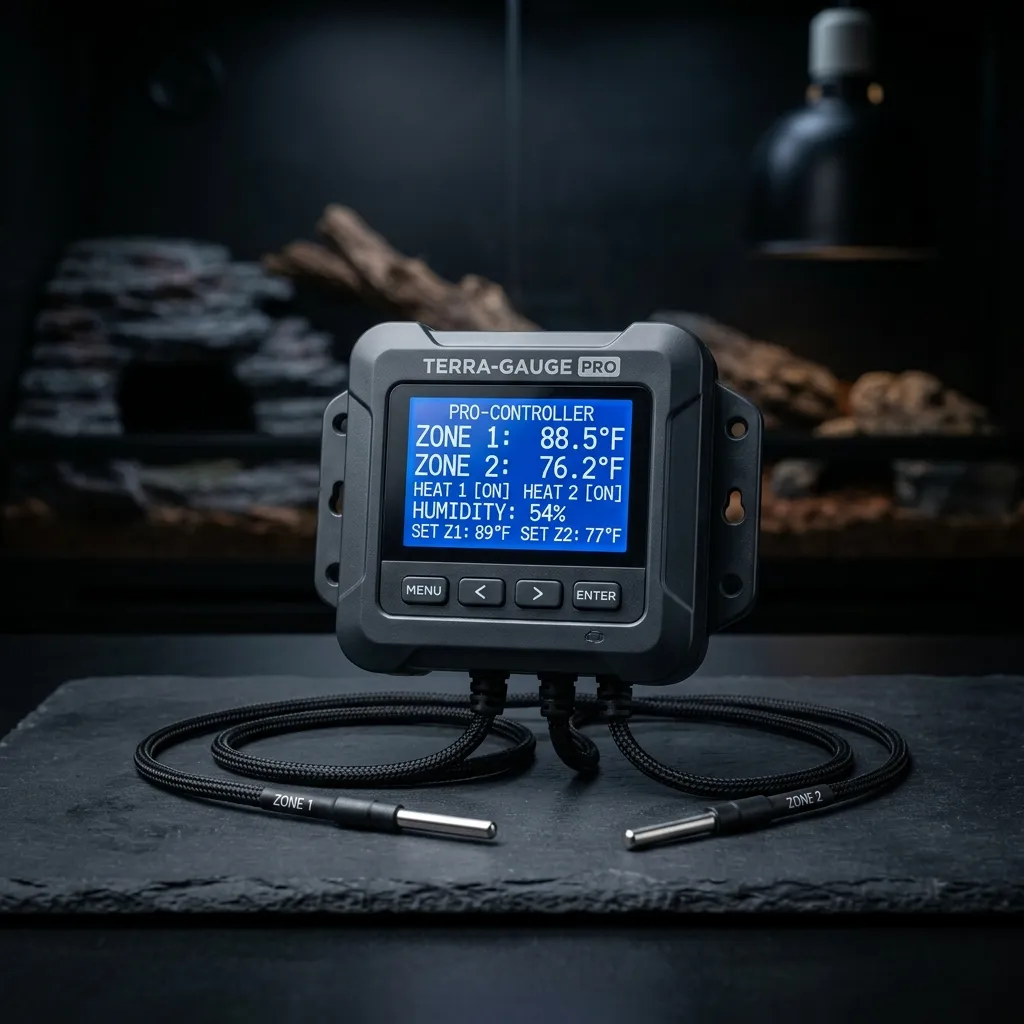
✅ Pros
- + Dual-stage relays allow you to plug in both a heating element and a cooling fan simultaneously.
- + Built-in high/low temperature alarms immediately alert you with a loud beep if the terrarium gets dangerously hot or cold.
- + The waterproof NTC stainless steel probe is highly accurate and safe to use in heavily misted tropical bioactive setups.
- + Incredibly easy to program with a simple 'set value' and 'heating/cooling differential' menu.
- + Can handle high-wattage loads up to 1200W, making it suitable for large enclosures or snake racks.
❌ Cons
- - It is a strict 'On/Off' thermostat, meaning it cannot gently dim halogen basking bulbs (dimming thermostats are much more expensive).
- - The user manual can be slightly confusing for beginners trying to understand the 'differential' settings.
- - The probe wire is relatively thick, which can make routing it through tight terrarium mesh holes difficult.
The Silent Danger of Unregulated Heat Sources
Reptiles are ectothermic, meaning they rely on their environment to regulate their body temperature. However, they are notoriously bad at realizing when their bellies are burning. If a snake sits over an unregulated under-tank heater (heat mat), it will often sit there until it suffers severe, sometimes fatal, third-degree burns. A reptile thermostat like the Inkbird prevents this by acting as a strict gatekeeper for electricity. It is not just about keeping the animal comfortable; it is about preventing lethal overheating. Whether you are controlling a ceramic heat emitter (CHE) for a leopard gecko or a radiant heat panel for a boa constrictor, precise terrarium temperature regulation is the foundation of responsible reptile husbandry.
Why We Trust Inkbird Over Pet Store Brands
At BioactiveHub, we have tested dozens of thermostats. The cheap analog dials found in big-box pet stores are notoriously unreliable and frequently fail in the 'ON' position, cooking the enclosure. We trust Inkbird because they originated in the strict home-brewing and greenhouse industries, where temperature fluctuations ruin expensive products. Their controllers are built like tanks. The dual-display screen simultaneously shows the current temperature and your target set-point, so you can check your terrarium's status with just a glance across the room. Furthermore, the audible high-temp alarm has literally saved our animals' lives during unexpected summer heatwaves.
Technical Specifications & Features
- ⚙️ Control Mode: On/Off (Bang-Bang) control.
- ⚙️ Temperature Range: -58°F to 210°F (-50°C to 99°C).
- ⚙️ Maximum Load: 1200W (110V) or 2200W (220V).
- ⚙️ Probe Type: NTC sensor (Waterproof stainless steel).
- ⚙️ Alarms: Audible High and Low temperature deviation alarms.
Installation Guide: Proper Probe Placement
Where you place the thermostat probe determines everything. If you are using a heat mat, the probe MUST be taped directly to the heat mat itself, outside the tank, or placed securely on the glass floor inside the tank directly above the mat. If you are controlling an overhead ceramic heat emitter (CHE), hang the probe in the air near the basking spot, but completely out of reach of the animal so it cannot be knocked down. Never bury the probe deep in the bioactive substrate, as the surface temperature will be drastically hotter than what the buried probe reads. Plug your heat source into the 'Heating' receptacle, set your desired temperature, and let the Inkbird do the rest.
Maintenance and Safety Checks
The Inkbird controller itself is virtually maintenance-free, but you should regularly inspect the sensor probe. Large snakes or active lizards can sometimes pull the probe out of place. If the probe is knocked to the cool side of the tank, the thermostat will think the basking spot is too cold and will leave the heat lamp on continuously, risking a fire. Check your probe placement weekly. Additionally, wipe the stainless steel probe gently with a damp cloth every few months to remove calcium buildup from misting systems, which can slightly insulate the sensor and delay its response time.
Alternative Thermostat Options
Because the Inkbird is an 'On/Off' thermostat, it will cause light-emitting bulbs (like halogens) to flash on and off annoyingly. If you want to control a halogen basking bulb, you must upgrade to a Dimming Thermostat (like the Herpstat by Spyder Robotics or the Exo Terra Dimming Thermostat). Dimming thermostats gently lower the power to the bulb rather than cutting it completely. However, if you are controlling non-light-emitting heat sources like Ceramic Heat Emitters (CHE), Deep Heat Projectors (DHP), or heat mats, the Inkbird is the most cost-effective and reliable choice on the market.
All Products