Bioactive Leopard Gecko Setup
Arid bioactive IS possible! Learn how to create a desert environment that supports burrowing.
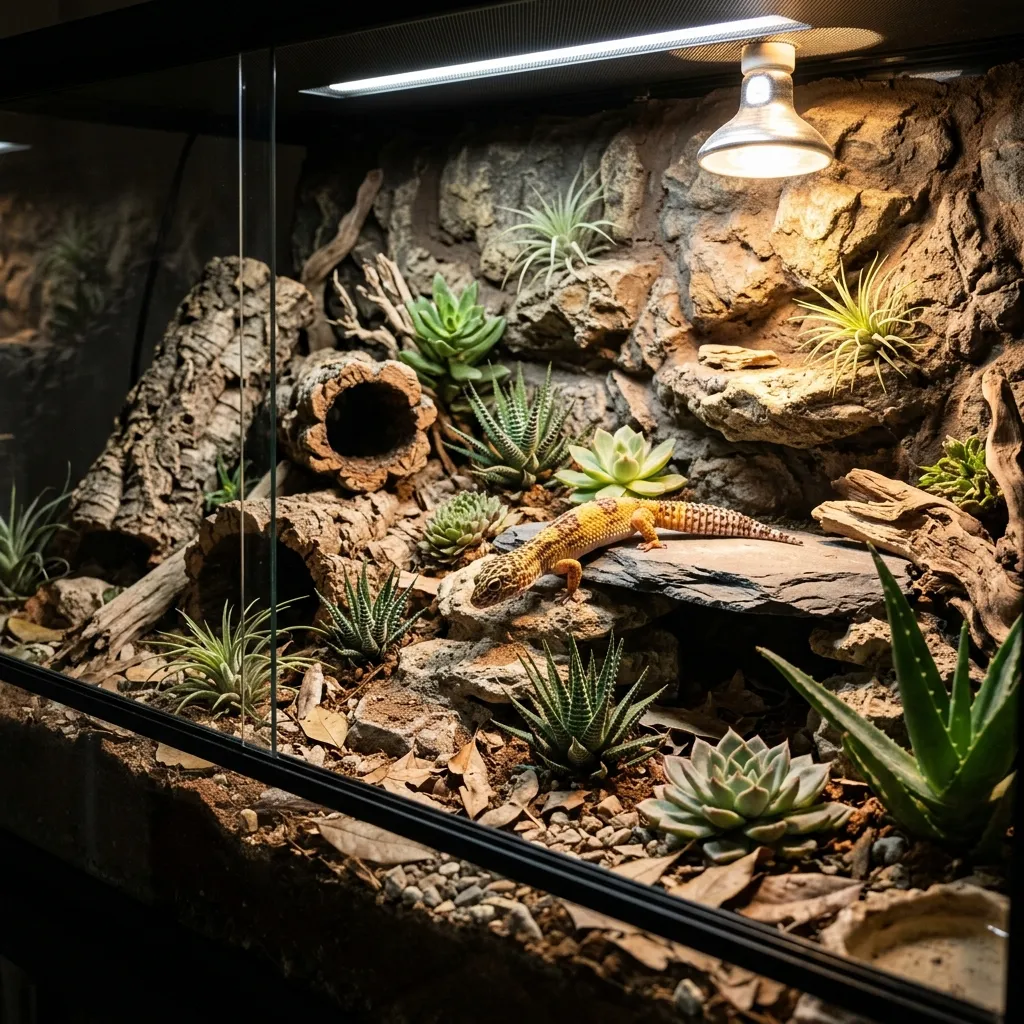
The Great "Bioactive Leopard Gecko" Myth
For a long time, there was a false consensus in herpetoculture: bioactive terrariums were limited to tropical species. Many argued that an arid bioactive environment was impossible because the "clean-up crew (CUC)" requires high humidity, which would supposedly cause respiratory infections in a leopard gecko.
The ecological reality is very different. Eublepharis macularius (leopard gecko) does not live on sterile, scorching sand dunes. In the wild, they come from semi-arid regions, steppes, and rocky outcrops of Afghanistan and India. They spend their days hiding in burrows dug in the dirt or under rocks, where the relative humidity reaches 70% or more. This subterranean microclimate is fundamental and proves that an arid bioactive setup is not only possible but highly beneficial for your reptile's environmental enrichment.
1. The Perfect Arid Substrate for Leopard Geckos
A good leopard gecko substrate in a bioactive system must mimic the compact soil of the steppe and allow for burrowing. Avoid tropical mixes like ABG.
- DIY 70/30 Mix (Top Soil / Play Sand): The quintessential economical recipe. It consists of 70% organic top soil (without fertilizers or perlite) mixed with 30% washed children's play sand. The soil provides nutrients for the plants and the sand improves drainage.
- Excavator Clay: By adding between 10% and 20% clay to the 70/30 mix, you achieve a substrate that wonderfully retains the shape of caves and burrows.
- Commercial Substrates (Arcadia EarthMix Arid / The Bio Dude Terra Sahara): If you prefer convenience, these expert-grade options come pre-inoculated with volcanic minerals and vital nutrients to replicate arid ecosystems perfectly.
2. Temperature, Thermal Gradient, and UVB Lighting
In a naturalistic terrarium, heating and lighting determine biological success. You must provide a proper thermal gradient (hot zone of 31°C - 33°C and cool zone of 23°C - 25°C).
- Halogen Basking Bulb: It is superior to the traditional heat mat because it penetrates the animal's muscle by imitating infrared solar radiation (IR-A and IR-B).
- Basking Slate or Rocks: Placing a dark flagstone under the heat lamp will create a thermal surface that retains natural heat for the gecko's digestion.
- UVB Lighting (ShadeDweller 7%): Absolutely crucial in bioactive setups. It prevents Metabolic Bone Disease (MBD), boosts Vitamin D3 synthesis, and greatly benefits the photoperiod of your live plants. Use a linear T5 UVB tube, never spiral lamps.
3. The Humid Hide: The Heart of the Ecosystem
Your ecosystem depends entirely on this element. The humid hide should ideally be placed in the center of the terrarium, between the warm and cool zones.
Fill it with soaked sphagnum moss. It serves two critical missions: it helps your gecko shed its skin without retention on its toes, and it acts as the base camp or "survival bunker" for your clean-up crew (CUC). When the terrarium surface is dry and hot during the day, the microfauna will retreat here to hydrate.
4. The Clean-Up Crew (Microfauna and CUC)
Your nature's recyclers. Since a leopard gecko generates nutrient-rich waste, the microfauna will consume it, preventing ammonia spikes. For arid setups, you need drought-resistant species:
- Arid Isopods (Porcellionides pruinosus): The "Powder Blue" or "Powder Orange" variants are extremely fast, voracious feces eaters, and withstand desiccation very well as long as they have access to the humid hide.
- Arid Springtails (Folsomia candida): These tiny arthropods are the infantry that attacks undesirable mold and fungus spores.
- Darkling Beetles (Tenebrio molitor): You can leave a few mealworms loose in the substrate. They will mature into dark beetles. The adult gecko is rarely interested in them due to their hard exoskeleton, but they are excellent sweepers of organic remains.
5. Safe Plants for Leopard Geckos
The plants in this terrarium must tolerate dry soil, intense lighting, and above all, not be toxic. The weight of an adult leopard gecko will destroy fragile plants, so opt for resilience:
- Aloe Vera and Haworthia: Unfailing classics. They are tough succulents, without dangerous spines, requiring very little watering and are 100% safe.
- Sansevieria (Snake Plant): Virtually indestructible, it grows vertically saving floor space for the gecko.
- Elephant Bush (Portulacaria afra): With woody growth, it provides a very aesthetic desert shrub look.
Water the plants locally (at the base) every 1-2 weeks instead of spraying the entire terrarium, to keep surface humidity low for your gecko.
Ready to build the desert?
Find safe sand, arid isopods, and UVB lighting in our product section.
View Gecko Products