Bioactive Maintenance: Less Work, Better Ecosystem
Although a bioactive system recycles most waste, it's not magic. Learn the expert routine to maintain long-term botanical health.
The Great "Zero Maintenance" Myth
There is a misconception that a bioactive terrarium is a magic box that cleans itself forever. While it is true that the clean-up crew (CUC) drastically reduces traditional maintenance (like changing all the substrate every month), an ecosystem enclosed in glass is still artificial and requires your intervention as a "park ranger."
Springtails and isopods will recycle feces and eat mold, but they won't clean fogged glass, prune invasive plants, or refill your reptile's water bowls. Let's get into the expert long-term care routine.
1. Daily and Weekly Maintenance
Your routine tasks should take less than five minutes:
- Spot Cleaning: If you keep a large snake (like a Ball Python) or a reptile that defecates massive amounts in one place, the CUC won't be able to process it in time. You must remove most of the large feces by hand, leaving only small remnants for the isopods to finish the job.
- Water Change: Wash your pet's water bowl daily to prevent bacterial proliferation.
- Humidity Check: Check your digital hygrometers. If you have an automatic misting system, make sure the reservoir is not empty.
2. Glass Cleaning and Reverse Osmosis (RO) Water
The white, opaque marks that ruin the visibility of your terrarium are not dirt; they are calcium and mineral deposits left by hard tap water when it evaporates.
The Solution: Use only Reverse Osmosis (RO) Water or distilled water for your misters and rain systems. It contains no minerals, so it will never stain the glass. To clean pre-existing hard water stains, use a 50% mixture of white vinegar and distilled water, rub with a paper towel, and dry it immediately. Vinegar is safe once it evaporates.
3. Monthly Botanical Pruning
In a healthy vivarium, with good LED lighting and nutrients processed by isopods, your plants will grow explosively. If you don't control them, they will block the light from lower plants and drastically reduce your reptile's movement space.
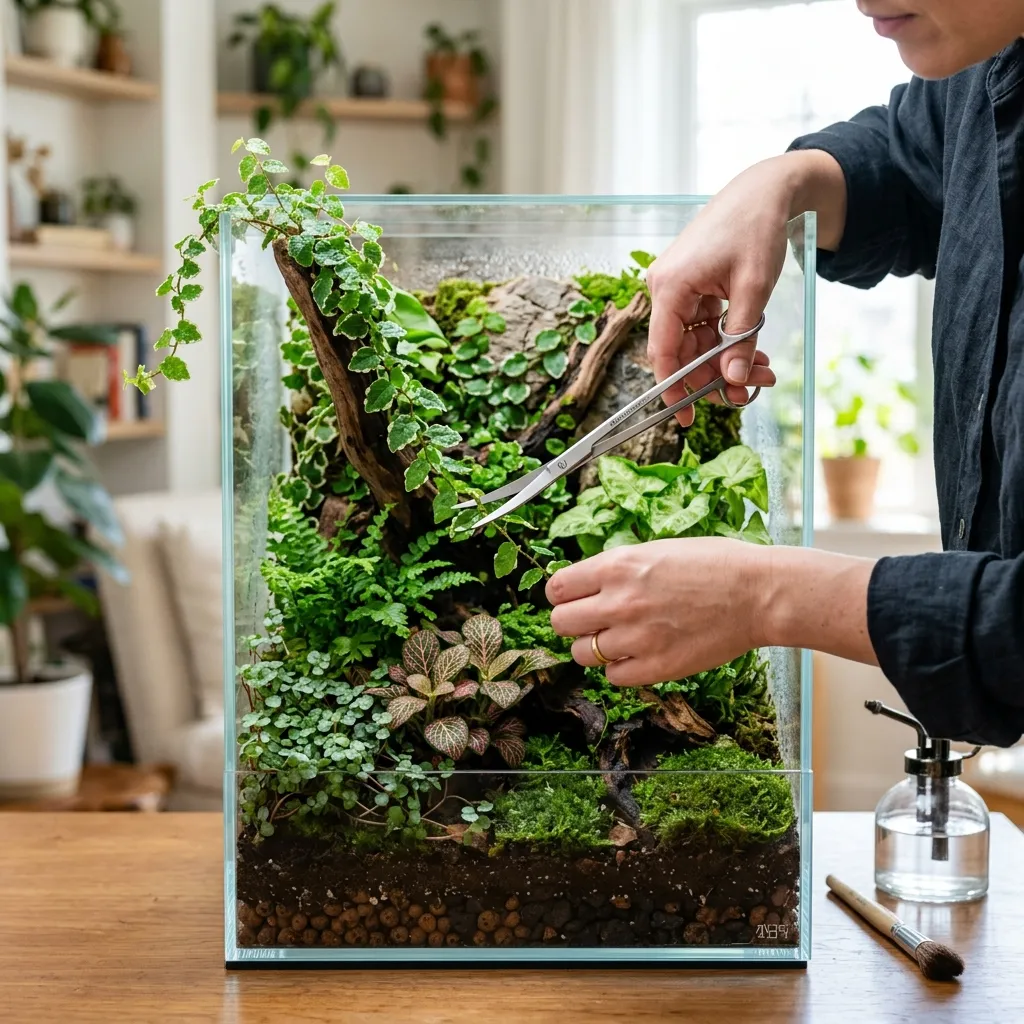
- Vine Trimming: Fearlessly prune Pothos and Creeping Fig using sterilized aquarium scissors. If you cut just below a leaf node, you can replant that cutting directly into the soil.
- Removing Dead Matter: Cut yellow or rotting leaves from mother plants. You can let them fall to the terrarium floor to feed the CUC.
- Canopy Control: Ensure that high branches do not completely block the radiation from your UVB lamp.
4. Leaf Litter Rotation (Quarterly)
The leaf litter layer is the fuel of your ecosystem. Over time, you'll notice whole leaves turn into fine veiny fragments and eventually disappear, merging with the ABG substrate.
Every 2 or 3 months, you must add thick handfuls of new dry leaves (Oak, Almond, Magnolia) on top. Occasionally, you can use a chopstick or long tweezers to very gently aerate the top layer of soil (only the first few inches) to prevent the substrate from becoming too compacted, being careful not to damage roots.
5. Health and Repopulation of Microfauna
If one day you notice the terrarium smells bad, green mold is growing uncontrollably, or your gecko's feces accumulate for days, it means your microfauna colony has collapsed.
- Nightly Visual Inspection: Springtails and isopods are active at night. Lift a piece of damp cork bark; you should see dozens of little bugs moving frantically.
- Repopulation: Sometimes, amphibians or small lizards eat a large part of your clean-up crew. Do not hesitate to inoculate the tank with a new culture (from your Master Culture) every 6-8 months if you notice a drop in their population.
Need botanical tools?
Find precision pruning shears, long tweezers, and quality misters in our store.
View Maintenance Tools