The Art of Lighting: UVB, LED, and PAR
Master the light spectrum. Discover how to simulate the sun to maximize your reptiles' health and your plants' growth.
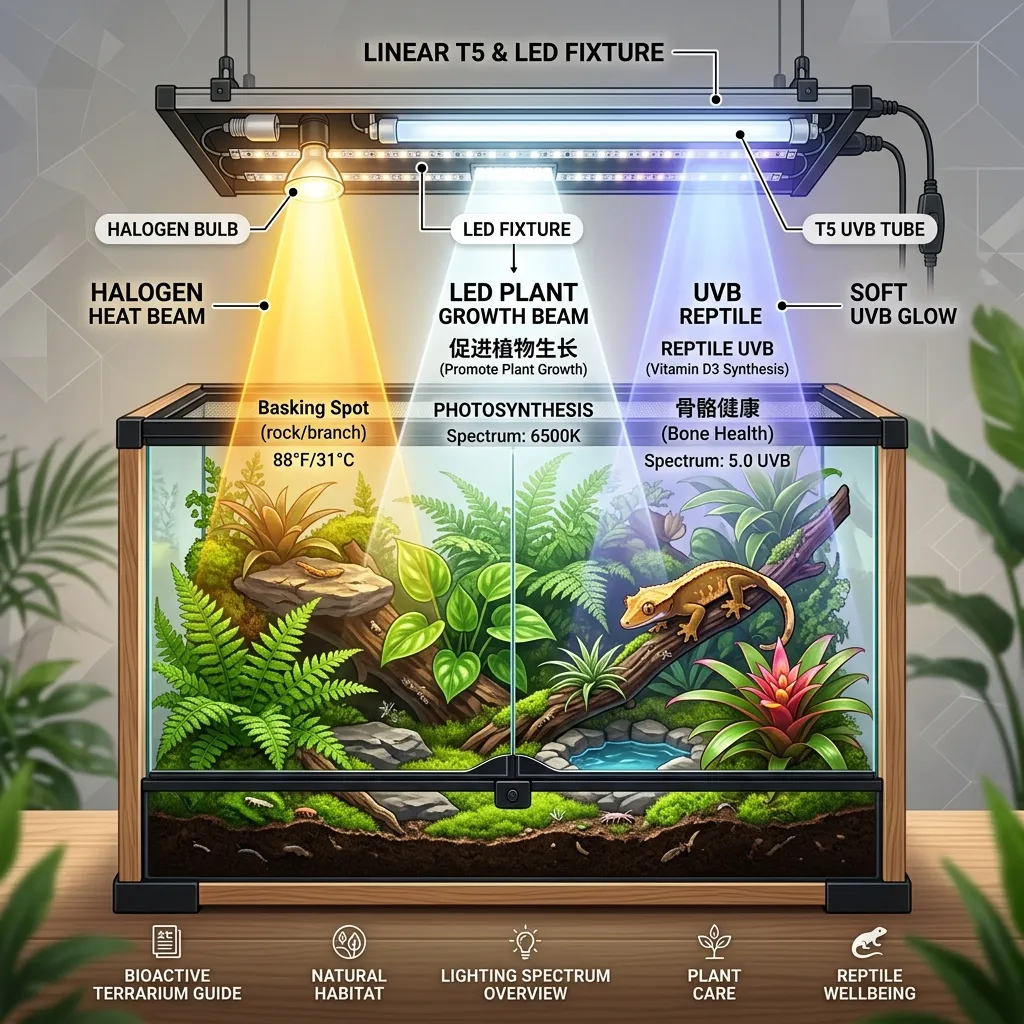
Simulating the Sun in a Glass Box
Lighting is the most misunderstood and poorly executed aspect in modern herpetoculture. In a natural environment, the sun provides heat (Infrared), visible light (for plants), and ultraviolet radiation (UVB for Vitamin D3 synthesis). In a bioactive terrarium, you must replicate these three elements separately using the correct technology.
If you fail at lighting, your plants will starve (lack of PAR) and your reptile will suffer irreversible diseases like Metabolic Bone Disease (MBD).
1. UVB Radiation: Life for Your Reptile
Reptiles need UVB to synthesize Vitamin D3 in their skin, allowing them to absorb calcium from their diet. Without UVB, their bones turn to rubber.
- Linear T5 Tubes vs Compact Spirals: Never use compact spiral bulbs. They emit dangerously high UVB levels in a tiny spot and can burn the reptile's eyes. Always use T5-HO Linear Tubes (High Output) that distribute radiation evenly.
- Ferguson Zones: Not all reptiles need the same sun. A Bearded Dragon (Zone 3-4) needs a 12% or 14% Arcadia tube, while a Leopard Gecko (crepuscular, Zone 1) needs a 7% ShadeDweller tube.
- Distance and Mesh: The top mesh screen of your terrarium blocks 30% to 50% of UVB light. Always measure the distance from the tube to your reptile's back using the manufacturer's recommendations (usually 12 to 16 inches).
2. LED Lighting: Botanical Fuel (PAR)
Your plants don't care how "bright" the light looks to the human eye (Lumens); they care about Photosynthetically Active Radiation (PAR). If you use cheap LED strips, your plants will slowly die.
- Full Spectrum (6500K): Look for LED bars specific for horticulture or terrariums (like Arcadia Jungle Dawn or Bio Dude Solar Grow). These lights mimic the color temperature of natural noon sunlight (6500 Kelvin).
- Canopy Penetration: In tall terrariums (like Crested Gecko setups), you need extremely high-power LED lights so photons can penetrate the upper leaves and reach the plants on the ground.
3. Heating: Infrared Radiation (IR)
The sun heats the earth through infrared radiation, warming objects and animals, not just the air.
- Halogen Basking Bulbs: They are the best daytime heat source. They emit IR-A and IR-B, which penetrate deep into the reptile's muscle tissue, promoting excellent digestion and circulation.
- Ceramic Heat Emitters (CHE) or Deep Heat Projectors (DHP): Perfect for nighttime heat (if your house temperature drops below 65°F), as they emit no visible light to disrupt your pet's sleep cycle.
4. Positioning: Creating the Gradient
All your light and heat sources (Halogen, Plant LED, and UVB Tube) must be grouped on one side of the terrarium.
This creates a perfect gradient: a bright, hot side (where the reptile "basks," absorbing heat and UVB simultaneously) and a dark, cool side where it can retreat to thermoregulate. Never put the heat lamp on one end and the UVB on the other.
Looking for the perfect spectrum?
Find T5 UVB tubes, full-spectrum LED bars, and halogen basking bulbs in our store.
View Lighting Gear